Tyromer Technology Asia Official Website

Asian Market – Regional Comprehensive Economic Partnership (RCEP)
RCEP is a free trade agreement among 15 countries: the 10 ASEAN member states, China, Japan, South Korea, Australia, and New Zealand. It aims to establish a modern, comprehensive, high-quality economic partnership that delivers mutual benefits.
With a combined GDP of approximately US$26 trillion, trade valued at US$10.4 trillion, and a population of 2.2 billion, RCEP represents around 30% of global GDP and population, making it one of the world’s largest regional free trade agreements.
Focus on China
China is a major tire-producing country. Six of the world’s top 30 tire manufacturers are Chinese, and China accounts for approximately 50% of global natural rubber consumption. As China is not a major natural rubber producer, its tire industry relies heavily on imports, making rubber a strategic resource.
To recover and reuse waste rubber, China has developed a large reclaimed rubber industry that uses chemical processing methods. The country produces approximately 5.5 million tonnes of reclaimed rubber annually, accounting for more than 90% of global production.
However, the use of chemical agents raises environmental concerns. Conventional chemical reclaiming processes can break not only sulfur cross-links but also the rubber’s molecular chains, compromising the original rubber’s dynamic properties. As a result, chemically reclaimed rubber is often limited to lower-performance applications, diminishing the value of the original tire rubber.
* For more information on the differences between TDP and reclaimed rubber, please refer to Professor Costas Tzoganakis’s article published in Rubber World magazine.
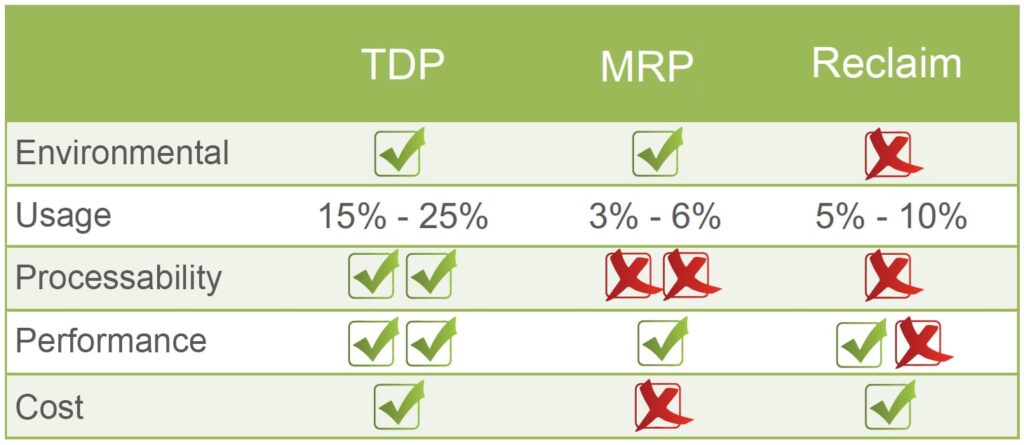
Producing TDP instead of chemically reclaimed rubber can significantly reduce the use of chemical agents. In addition, China’s tire industry consumes approximately 15 million tonnes of tire rubber compounds annually, relying heavily on imported rubber resources. Using TDP can provide a stable domestic source of tire rubber, reduce dependence on foreign supplies, and lower the industry’s carbon footprint.
Tyromer’s Commercial and Social Value
1
Tyromer has established itself as a globally recognized brand, serving leading tire manufacturers, major rubber compounders, and wholesale distributors worldwide.
2
Supports the low-carbon economy, aligns with global decarbonization strategies, enables sustainable growth, and enhances business competitiveness and profitability.
3
Promotes the green transformation of the industry, demonstrates investor responsibility, and advances environmental protection and ecological awareness.
4
Proprietary technology and industry expertise, production know-how, R&D capabilities, and a global growth strategy.
Tyromer’s Partners
For Tire Manufacturers
Tyromer provides a cost-effective, sustainable material that advances the circular economy and helps address producer responsibility. It enables tire brands to achieve their sustainability and recycled-content targets more quickly.
For Rubber Product Manufacturers
Tyromer provides a versatile, cost-effective material made from an abundant resource, with lower price volatility and 100% recycled content.